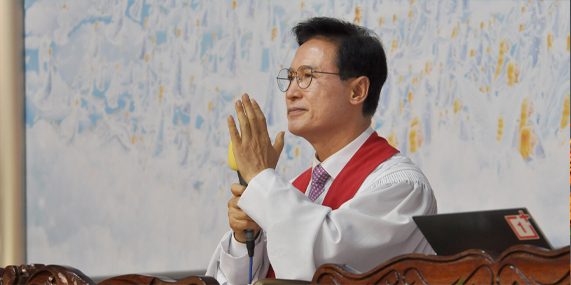
When Your Attitude Changes, Your Life Changes
Bible passage: Exodus 15:22–27
“22. Then Moses led Israel from the Red Sea and they went into the Desert of Shur. For three days they traveled in the desert without finding water. 23. When they came to Marah, they could not drink its water because it was bitter. (That is why the place is called Marah.) 24. So the people grumbled against Moses, saying, "What are we to drink?" 25. Then Moses cried out to the LORD, and the LORD showed him a piece of wood. He threw it into the water, and the water became sweet. There the LORD made a decree and a law for them, and there he tested them. "
William James, a pragmatist philosopher at Harvard University, is famous for his diverse studies on human nature. He once presented a famous research finding: “If a person changes just this one thing, their life will change.” What is this one thing that he said could change your life?
On the screen, we have displayed a quote from Professor William James. Can you guess the word that fits in the parentheses? “The greatest discovery of our generation is that a human being can change their life by changing their
( ).” Some might think it’s their appearance. Others might believe it’s their education, personality, or environment - opinions will vary from person to person. However, it’s not an external condition that changes one’s life. The correct answer to fill in the parentheses is “attitude.” Life’s attitude, the attitude of the mind. Human beings can change their lives by changing their attitude. There’s a convincing example that supports this finding. Dr. Viktor Frankl, an Austrian Jewish psychologist and physician, survived the horrors of the Auschwitz concentration camp during World War II. Despite facing death and despair, he endured with incredible mental strength and lived to tell his story.
Reflecting on his distressing experiences in the Auschwitz camp, he reached a profound conclusion. This, too, is displayed on the screen. Can you guess the word that completes the parentheses? “You can take away every freedom from a person, but no matter the circumstances, the freedom to choose one’s ( ) toward life cannot be taken away.” The answer is the same: attitude. Frankl emphasized that, while we may not be able to change the challenges or situations life brings us, we can choose our attitude toward them. He said, “The Nazis could take everything from me, but the one thing they couldn’t take away was my attitude in this situation.
And because I held onto that, I was able to live with hope even in the despair of the camp.” This demonstrates the power of attitude. Now, let’s think about the Israelites in today’s Bible passage. The Israelites successfully crossed the Red Sea under Moses’ leadership. As God’s chosen people, they experienced God’s special protection and help as they moved to conquer Canaan. Yet, ironically, if we read the Old Testament, they ultimately became a nation that faced destruction. Today, we will explore the fundamental reason for this downfall through the passage and draw lessons for our own lives.
1. To guarantee victory in life, you must accurately identify the cause of your failures.
Just as a disease can only be cured when its cause is identified, if there are failures in your life, you must pinpoint their cause to live a successful life. In today’s passage, Exodus 15:22-23, the event occurs three days after the Israelites miraculously crossed the Red Sea on dry ground by God's power. What is the first event the Israelites experienced after crossing the Red Sea? It’s the "bitter water at Marah" event mentioned in the scripture.
Just as first loves, first experiences, and first memories carry special significance, the first event, the "bitter water at Marah," also holds important meaning. After crossing the Red Sea, the Israelites traveled for three days without finding water. When they came upon a pool at Marah, they wanted to drink from it but found the water too bitter to drink. If the first event the Israelites experienced after leaving Egypt was the “bitter water at Marah,” what was their first reaction to God? Surprisingly, it was not gratitude but complaints and grumbling. Exodus 15:23-24 says, “When they came to Marah, they could not drink the waters of Marah, for they were bitter; therefore it was named Marah.
So the people grumbled at Moses, saying, “What shall we drink?”” However, even though the Israelites complained instead of giving thanks, God did not rebuke them. Instead, He responded to Moses’ prayer and demonstrated His amazing power by turning the bitter water into sweet water. Furthermore, as mentioned in verse 27, God led them to Elim, a place abundant with water and suitable for living, filled with 12 springs and 70 palm trees. It says, “Then they came to Elim where there were twelve springs of water and seventy palm trees, and they camped there beside the waters.” Now, take a closer look.
After experiencing the miraculous provision of sweet water and enjoying the abundance of Elim as an oasis for about two and a half months, they left that place. What happened next? Exodus 16:1-2 says, “Then they set out from Elim, and all the congregation of the sons of Israel came to the wilderness of Sin, which is between Elim and Sinai, on the fifteenth day of the second month after their departure from the land of Egypt. The whole congregation of the sons of Israel grumbled against Moses and Aaron in the wilderness.” What are the Israelites doing now in the wilderness? They are grumbling again.
Even after experiencing the extraordinary miracle of the Red Sea parting, the transformation of bitter water into sweet water, and the abundant provision at Elim, the Israelites still had no gratitude and would complain at the slightest difficulty. This was the attitude of the Israelites throughout their time in the wilderness - a mindset and way of life characterized by constant complaints and grumbling. Why were the Israelites so prone to grumbling and complaining, even to the point of being incomprehensible? It was because, before leaving Egypt, the Israelites had lived as slaves for 430 years.
Their long period of slavery had implanted a "slave mentality" into their way of thinking. What is a slave mentality? It refers to a lack of self-determination and an attitude of constantly seeking approval from others. It is a mindset that lowers oneself and, when faced with hardships, responds with complaints, and when confronted with difficulties, defaults to grumbling. Because the Israelites couldn’t rid themselves of their slave mentality, complaints, and grumbling, even after witnessing countless miracles performed by God, they ultimately faced destruction at the hands of the Assyrians and Babylonians.
In other words, while political, economic, and social factors may have contributed to their downfall, the fundamental cause was the unhealthy attitude within their hearts. There is an interesting story in the book ‘Attitude is Everything’. A patient once visited a doctor, complaining of pain all over their body. “Doctor, I feel like I’m going to die because every part of my body hurts. If I touch my knee, it hurts. If I touch my stomach, it hurts. If I touch my head, it hurts. Even if I touch my back, it hurts. What’s wrong with me?” The doctor conducted a thorough X-ray examination and found the cause, explaining it to the patient as follows: “Your body is perfectly fine.
The reason you feel pain everywhere is that your finger is broken.” Because the patient’s finger was broken, he felt pain no matter where he touched. So, the solution wasn’t to fix the entire body but to heal the broken finger. Here, the “finger” symbolizes life’s attitude. Just as a broken finger causes pain everywhere, a flawed attitude leads to problems in all aspects of life. Therefore, by healing the broken finger - by changing your attitude - you can lead a healthy life. The Bible also addresses this issue concerning Jesus Christ. Philippians 2:5 says, “In your relationships with one another, have the same attitude as Christ Jesus:” Philippians 2:9-11 says, “Therefore God exalted Him to the highest place and gave Him the name that is above every name, that at the name of Jesus every knee should bow, in heaven and on earth and under the earth, and every tongue acknowledge that Jesus Christ is Lord, to the glory of God the Father.”
To receive such victory, glory, and blessings, your mindset must be the same as Jesus Christ’s. What is this attitude? The Bible says, "Have the same attitude as that of Christ Jesus." This refers to Jesus’ attitude toward the sick and marginalized, His attitude toward the cross, His attitude when crowds tried to make Him king, and His attitude when confronting those who defiled the holy temple. The Bible tells us to emulate or resemble Jesus’ attitude. The word attitude originates from the Latin word aptus, meaning "prepared" or "adapted." Psychologist Carl Jung expanded this definition, describing attitude as a "mental readiness to act or respond in a particular direction."
Everyone has a different attitude. When facing situations or meeting people, some are prepared to react negatively, while others, having chosen a positive attitude, respond constructively, transforming even negative situations. This is the power of "attitude." Even if you experience miraculous events or God’s mighty power, without correcting your attitude, you will still face destruction. 1 Corinthians 10:1-5 says, [1] For I do not want you to be unaware, brethren, that our fathers were all under the cloud and all passed through the sea; [2] and all were baptized into Moses in the cloud and in the sea; [3] and all ate the same spiritual food; [4] and all drank the same spiritual drink, for they were drinking from a spiritual rock which followed them; and the rock was Christ. [5] Nevertheless, with most of them God was not well-pleased; their bodies were scattered in the wilderness.
And in verse 10 it says, “And do not grumble, as some of them did—and were killed by the destroying angel.” Just as diagnosing the root cause of an illness is essential for treatment, recognizing that your life’s failures stem from your attitude is the first step. From now on, by changing your attitude, may you transform your life into one filled with victory, blessings, and happiness.
2. We must correct unhealthy attitudes into healthy ones.
When we look at the Israelites in today’s passage, we can find two unhealthy attitudes of the heart that need to be corrected. The first is a “hopeless attitude” toward oneself, and the second is a “blaming attitude” toward others. There are two types of attitudes: one is an inward attitude, and the other is an outward attitude. An inward attitude is a life attitude directed toward oneself, and a person who is not healthy in this regard will always have thoughts of failure come to mind first.
They are dominated by negative emotions and constantly say things like “It’s not going to work.” This type of negative attitude is an unhealthy life attitude. This internal attitude of life flows outward and is expressed when dealing with others, which is called an outward life attitude. Such a person always blames others. “This happened because of you. Isn’t this because I met you? You are the one at fault.” They often say such things. It’s all “others’ fault, circumstances’ fault,” and this is the unhealthy life attitude that we must cut off.
In Exodus Chapter 16, we see that the Israelites, when they faced something that didn’t go their way, would say it was better to live as slaves in Egypt. Exodus 16:3 says, “The Israelites said to them, “If only we had died by the LORD’s hand in Egypt! There we sat around pots of meat and ate all the food we wanted, but you have brought us out into this desert to starve this entire assembly to death.”” Would slavery really have been better? Being free is better. Yet the Israelites always spoke this way. Because their mindset was unhealthy, they belittled and denied themselves, always saying things would not work out.
This is the “hopeless attitude toward oneself” that we must change. In Numbers, when Moses was about to conquer Canaan, he sent 12 spies to explore the land of Canaan. Ten of the twelve spies reported as follows: They said in Numbers 13:33, “We saw the Nephilim there (the descendants of Anak come from the Nephilim). We seemed like grasshoppers in our own eyes, and we looked the same to them.” Here, we need to understand the principle of relativity in interpersonal relationships. If I see myself as a grasshopper, others will also see me as such. If I perceive myself as insignificant, others will also label me as insignificant. After the Israelites crossed the Red Sea and before they entered the land of Canaan, they sent 12 spies to spy the land. Although they all saw the same place, the spies reported differently. Of the 12, as many as 10 said, “We can’t win. We are doomed.
They are enormous. We are like grasshoppers.” A grasshopper, after all, is something whose legs break off with just two shakes when caught, and that’s how they described themselves. Among the 12, only two, Joshua and Caleb, said, “What are you talking about? What do you mean they are strong? God promised to give us that land. We can win against them. They are our food.” The Israelites numbered around 600,000 adult males at that time, and the 12 spies were chosen as representatives from each tribe, meaning they were likely the most outstanding individuals. If 12 people were selected as representatives out of 600,000, they would have been highly capable and faithful individuals. However, shockingly, out of the 12, only two operated in faith and exhibited a positive mindset.
Even among the Israelites led by Moses, a servant of God’s power, such statistics emerged. This indicates the seriousness of the issue. Reflecting on the Bible’s examples, consider this: if about 1,000 people are gathered here for worship, approximately 167 individuals would have faith like Joshua and Caleb and possess a healthy life attitude based on the 2/12 ratio. Among the congregation, 167 people might belong to the group of Joshua and Caleb, while the remaining 833 belong to the group of the 10 spies with unhealthy life attitudes. What should we do about this? We must be deeply alert in our faith. When faced with real-life challenges, difficulties in the family, or tough circumstances, do you belong to the group of 2 or the group of 10?
Even the 10 spies were chosen for their faith, but when confronted with reality, their negative life attitudes took over. Despite God’s promise that He would give them the land, they forgot His word and said, “We are doomed. We are grasshoppers. We can’t win.” Their words influenced the people, leading them to cry and wail all night, blaming God and Moses. The people resented Moses and Aaron, saying it was better to return to slavery. At this point, God declared a profoundly important spiritual principle that we must remember. Numbers 14:28 says, “So tell them, ‘As surely as I live, declares the LORD, I will do to you the very thing I heard you say:”
To the 10 spies, He said, “Did you just say you’re grasshoppers? Fine, you will live as grasshoppers as you have said.” To Joshua and Caleb, He said, “Did you just say, ‘We are weak, but we can win because God promised the land, and they are our food’? Then I will make you victorious as you have said.” Your circumstances do not determine your ruin. It is when you accept them as disastrous and keep speaking as such that things start to crumble. This is what we might call the “boomerang effect.” A boomerang, used by Australian natives for hunting, flies through the air and returns to the thrower, making it a handy tool for catching prey. Just as God said, “As I heard you say, so I will do to you,” the words you speak come back to you like a boomerang. So instead of saying, “I am a grasshopper” like the 10 spies, speak like the two spies, Joshua and Caleb, who said, “They are our food.
If God is with us, we can win.” Another unhealthy life attitude that must be corrected is the attitude of blaming others. As soon as they crossed the Red Sea and encountered the bitter water at Marah, their first reaction was to blame others. Exodus 15:24 says, “So the people grumbled against Moses, saying, “What are we to drink?”” This blaming attitude persisted throughout their time in the wilderness, as recorded in Numbers 14:2. It says, “All the Israelites grumbled against Moses and Aaron, and the whole assembly said to them, “If only we had died in Egypt! Or in this wilderness!” Beloved believers, clench your teeth and refuse to harbor a “hopeless attitude toward yourself,” thinking, “I can’t do it. I’m a miserable person. I can’t recover.”
Replace this attitude with the victorious mindset of “If God is with me, I can do it.”
3. You need to train yourself to change the attitude of a failure into the attitude of a success.
Dr. Viktor Frankl, based on his experiences and observations in the Auschwitz concentration camp, discovered an important concept: the "space between stimulus and response." He observed something remarkable in Auschwitz. Even though everyone was confined to the same desperate circumstances, some people lost their humanity, fell into despair, became depressed, committed suicide, or went insane. Yet, there were others who never lost their dignity or hope and refused to give up on life despite the conditions. The question he asked was, "Where does this difference come from?" In the same hopeless concentration camp, why do some succumb to despair while others maintain their dignity and hope?
The key principle he discovered is the "space between stimulus and response." He explained that humans don’t immediately react to stimuli in their lives; instead, there is a moment of thought before a response is made. He called this the "space between stimulus and response," and the depth and breadth of this space influence one’s subsequent actions. This is where we understand the importance of spiritual life. Thinking of the Lord, meditating on His Word, and praying to God are ways to secure this “space between stimulus and response.” This space allows us to pause when something happens and create a moment for reflection and prayer.
Training to change your attitude involves expanding and deepening this space as much as possible. In today’s passage, we see the Israelites reacting impulsively with complaints and grumbling whenever something happened because they lacked this “space between stimulus and response.” In contrast, Moses, who maintained communion with God, had no complaints or grumbling because he utilized this space effectively. In modern times, people often rush to handle things, respond without deep thought, or argue impulsively out of anger. Such behaviors - impulsive assault, impulsive murder, or rash decisions - result from not having this “space between stimulus and response.”
If we believe that our attitudes can determine the success or failure of our lives, we must diligently and deeply pray to God and meditate on Jesus so that we can utilize this space. Hebrews 3:1 says, “Therefore, holy brothers and sisters, who share in the heavenly calling, fix your thoughts on Jesus, whom we acknowledge as our Apostle and High priest.” In every situation, think: "What would the Lord say?
How would the Lord respond in this situation?" By doing so, you can secure this space. Training to change your attitude also involves cultivating “future-oriented goals.” A critical shortcoming in the Israelites’ attitude was their constant fixation on the past. In the book of Exodus, whenever an opportunity arose, they talked about returning to Egypt instead of moving forward to Canaan. Numbers 14:2-4 says, [2] All the Israelites grumbled against Moses and Aaron, and the whole assembly said to them, “If only we had died in Egypt! Or in this wilderness! [3] Why is the LORD bringing us to this land only to let us fall by the sword? Our wives and children will be taken as plunder.
Wouldn’t it be better for us to go back to Egypt?” [4] And they said to each other, “We should choose a leader and go back to Egypt.” They wept and said they wanted to return to Egypt. They claimed it was better to be slaves, making bricks and doing hard labor, than their current situation. Don’t be deceived by the past. Many people say, “Those were the good old days.” “Things were better back then.” But what was so good about the past? Isn’t now better? Yet, they always long to go back, thinking the past was better. If you believe that your attitude determines your future, then the situations you face today should become the building blocks for becoming a future-oriented person.
Nick Vujicic, an Australian pastor, motivational speaker, and founder of the organization Life Without Limbs, is an inspiring example. Born with severe disabilities - without arms or legs, just a torso, a face, and a foot with two toes - his condition alone might seem heartbreaking. Yet, despite his physical limitations, he inspires countless people. He dives off high diving boards, skateboards, surfs, plays drums, and enjoys life with joy and a sense of challenge. When he visited South Korea in 2013, he appeared on television, touching and inspiring many viewers with his story. During his youth, he faced tremendous despair, attempting suicide three times, only to fail due to his physical limitations.
At age of 15, however, he met God personally, and his life attitude transformed. He began to live a life of hope and encouragement, inspiring countless others. He now runs motivational campaigns with a key message: "Attitude determines altitude." He emphasizes that one’s attitude determines the heights they reach in life. Regardless of their circumstances, the way they perceive and respond to their situations defines their life’s trajectory. Despite being born into the worst possible conditions, Nick discovered that life is not determined by circumstances but by the attitude one takes toward them. What is your life attitude today?
Does anyone here think they are in a more challenging situation than Nick Vujicic? If he can live positively and optimistically, influencing others with goodness, there’s no reason any of us can say, “I’m too weak to do the same.” To transform attitudes, we must train ourselves with God’s Word. For example, Psalm 100:3-4 offers guidance. Let’s read verse 4: It says, “Enter His gates with thanksgiving and His courts with praise; give thanks to Him and praise His name.” Do you give thanks as you walk through the doors of your home after a day’s work? Do you enter with gratitude when coming to church? From now on, as we have learned today, let us give thanks whenever we pass through a door, whether it is at home or church. As the verse from 1 Thessalonians 5:16 on the sanctuary wall reminds us, “Rejoice always,” whether you like it or not, rejoice.
“Pray without ceasing” means praying continuously, which trains us to adopt the attitude of a successful person. Train yourself to become someone who gives thanks and prays, as this is how to develop a healthy life attitude. Just as Nick Vujicic met God and changed his attitude toward life, as we enter the final month of 2024, may you lay down the attitude of a failure and end the year by adopting the positive, successful attitude that God has prepared for you. Many people believe that when their life changes - when their circumstances improve and their desires are fulfilled - their negative attitude will change.
However, God tells us to reverse the order. He says, “Change your attitude first, and your life will follow.” Conclusion Let me share a part of a poem from the book ‘Attitude is Everything’: “This ship sails east, and that ship sails west, Though the same winds blow. The direction they travel depends not on the winds, But on the setting of the sails. Even when storms rage on life’s sea, What determines where we go Is not the storm, But the direction of our hearts.” To those who began their marriage with hope but now endure unimaginable pain caused by their partner, to those facing storms of hardship in their business, and to those whose health has been swept away by the winds of illness - remember this: ~ The direction of your life is determined not by the winds but by the setting of your sails.
~ Your happiness is not determined by your circumstances but by the attitude you hold toward those circumstances, and this attitude shapes your future and happiness. A life without storms is not a happy life. Even when storms rage, the direction your life takes is not decided by the storm but by the setting of your sails - that is, your attitude. So instead of suffering from the storms that arise in your life, transform your attitude into a healthy, positive, and successful one. May you, by doing so, turn your life into one of success, happiness, and victory. In the name of the Lord, I bless you to walk this path. - END -